Key Takeaways:
- African blockchain companies raised $122.5 million in 2024, down 36% from previous year
- Deal count increased to 30 from 26, but average deal size dropped significantly
- Nigeria led in deal volume while Seychelles topped funding value
- Centralized exchanges dominated funding, capturing nearly 50% of total investment
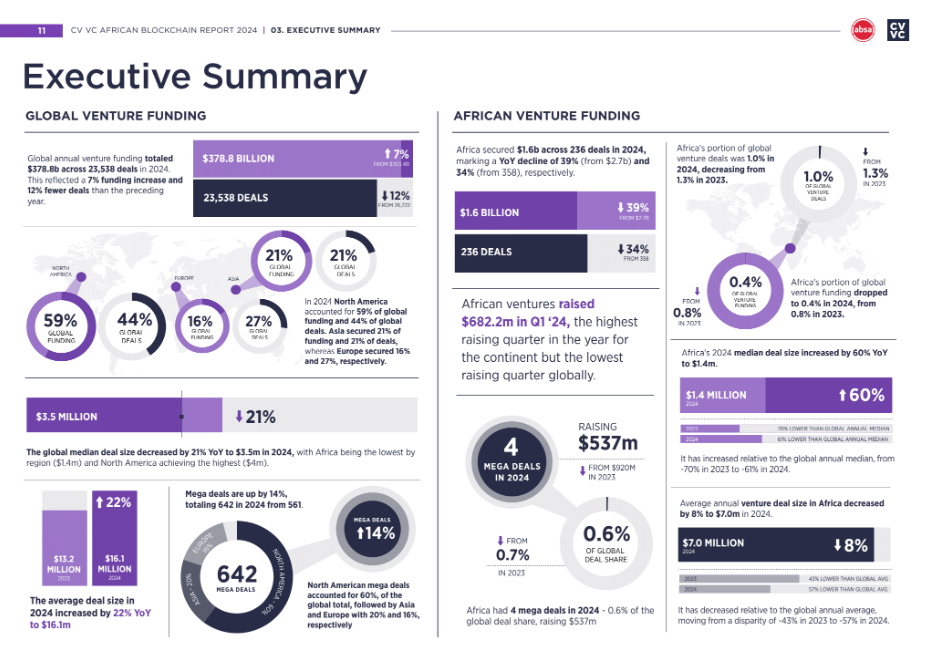
The African blockchain ecosystem experienced a challenging funding environment in 2024, with venture capital investment declining substantially despite an uptick in deal activity, according to the latest African Blockchain Report by CV VC and Absa Bank.
Funding Landscape Shows Mixed Signals
African blockchain startups secured $122.5 million in venture capital funding throughout 2024, representing a 36% decline from the $190.7 million raised in 2023. This downturn reflects broader market caution and the ongoing recovery from previous funding peaks that characterized the cryptocurrency boom period.
Despite the reduced funding volume, the continent saw a modest increase in deal activity, with 30 funding rounds completed compared to 26 in the previous year. However, this figure remains well below the 48 deals recorded during the sector’s peak in 2022, indicating that the African blockchain funding market has yet to fully recover.
The average deal size in Africa dropped by 44% year-over-year and stood 56% below the global average for blockchain venture capital funding. This disparity highlights the ongoing challenges African blockchain entrepreneurs face in accessing substantial capital compared to their international counterparts.
Continental Market Share and Global Context
Africa’s share of global blockchain venture capital funding reached 2.3% in 2024, a marginal improvement from 2.1% in 2023. While this represents a slight increase in relative terms, the absolute funding decline underscores the challenging investment climate facing African blockchain companies.
The report, compiled by Swiss-based venture capital firm CV VC in partnership with South African banking giant Absa, focuses on companies either headquartered in Africa or serving predominantly African user bases. To qualify for inclusion, companies must have raised at least $100,000 in venture capital funding between January and December 2024.
Notably, the analysis excludes companies that secured funding through debt financing or grants, alternative funding mechanisms that many early-stage African blockchain startups are increasingly exploring as traditional venture capital becomes more difficult to access.
Geographic Concentration: The ‘Big Five’ Markets
The funding landscape remained highly concentrated, with all 30 recorded deals occurring in just five African countries: Kenya, Morocco, Nigeria, Seychelles, and South Africa. This concentration reflects the uneven development of blockchain ecosystems across the continent and the concentration of investor interest in established tech hubs.
Nigeria Leads in Deal Volume
Nigeria emerged as the most active market, securing 10 funding deals throughout 2024. The country’s funding performance showed remarkable improvement, with total investment jumping from $1.5 million (0.8% of continental total) in 2023 to $18.9 million (15.4%) in 2024. This surge demonstrates growing investor confidence in Nigeria’s blockchain ecosystem and its large domestic market potential.
Seychelles Maintains Value Leadership
Despite Nigeria’s strong performance in deal count, Seychelles retained its position as the top destination by funding value. Blockchain companies headquartered in the island nation raised $38.9 million across eight deals, though this represented a significant decline from the $89 million secured in 2023.
The report acknowledges that several global companies classify themselves as Seychelles-based for regulatory reasons while maintaining limited operational ties to Africa. CV VC notes that including such companies may overstate actual Africa-focused funding and should be considered when interpreting the data.
Other Market Developments
Morocco re-entered the funding landscape with a $1.5 million deal after recording no blockchain funding in 2023. Meanwhile, Kenya and South Africa maintained their positions as consistent recipients of blockchain investment, though specific figures for these markets were not detailed in the available data.
Sector Analysis: Exchange Platforms Lead Investment
The distribution of funding across different blockchain sectors reveals clear investor preferences, with centralized exchanges capturing the largest share of available capital.
Centralized Exchanges Dominate
Centralized cryptocurrency exchanges attracted nearly 50% of all blockchain venture capital in Africa during 2024. Key players in this category included Kredete, Yellow Card, and Zap Africa, reflecting investor confidence in trading platforms that serve the growing demand for cryptocurrency access across the continent.

Yellow Card emerged as the standout performer, raising $33.2 million in a Series C funding round, more than triple the amount secured by the second-highest funded company, Azuro. This substantial raise significantly influenced the overall funding statistics and demonstrates the potential for African blockchain companies to secure significant capital when they achieve scale.
DeFi and Other Sectors
Decentralized finance (DeFi) platforms represented the second-largest funding category, capturing 29.6% of total investment. Companies like Canza Finance led this segment, highlighting growing interest in decentralized financial services across Africa.
Blockchain data and analytics firms, including Agridex and BanQu, accounted for 19.9% of deals, while infrastructure and developer tools companies received 4.3% of funding. Gaming, NFT, and metaverse-focused companies attracted 5.7% of investment, indicating nascent but growing interest in these emerging sectors.
Notable Funding Rounds and Companies
Several companies stood out in the 2024 funding landscape:
- Yellow Card: The pan-African cryptocurrency exchange raised $33.2 million in Series C funding, representing the largest single deal of the year
- Zone Network: The Nigeria-based blockchain infrastructure company secured $8.5 million in funding
- Zap Africa: Another Nigerian firm raised $300,000 to expand its blockchain services
- Azuro: While not detailed in the source, this company emerged as the second-highest funded after Yellow Card
Market Challenges and Outlook
The 2024 funding data reveals several key challenges facing African blockchain startups:
Reduced Deal Sizes
The 44% decline in average deal size compared to 2023 suggests that investors are taking more cautious approaches to African blockchain investments. Companies are securing funding, but at lower valuations and smaller amounts than in previous years.
Global Funding Gap
The 56% gap between African and global average deal sizes indicates that African blockchain companies continue to face structural disadvantages in accessing capital compared to their international competitors.
Concentration Risk
The concentration of deals in just five countries highlights the uneven development of blockchain ecosystems across the continent and suggests that many African markets remain underserved by venture capital.
Methodology and Data Considerations
The African Blockchain Report employs specific criteria that may influence the reported figures:
- Companies must be headquartered in Africa or serve predominantly African user bases
- Minimum funding threshold of $100,000 in venture capital
- Exclusion of debt financing and grant funding
- Inclusion of some globally-focused companies domiciled in Seychelles for regulatory reasons
CV VC acknowledges that including Seychelles-based companies with limited African operations may overstate actual Africa-focused funding, urging readers to consider this when interpreting the data.
Industry Implications
The 2024 funding landscape suggests several important trends for African blockchain development:
- Investor Caution: The decline in funding volume reflects broader market uncertainty and more selective investor behavior
- Exchange Infrastructure Priority: The dominance of centralized exchange funding indicates investor focus on basic cryptocurrency infrastructure
- Market Maturation: The increase in deal count despite lower values suggests a maturing market with more companies seeking funding
- Geographic Concentration: The concentration in five countries highlights the need for broader ecosystem development across Africa
Looking Forward
As African blockchain startups navigate this challenging funding environment, several factors will likely influence future investment patterns:
- The continued development of regulatory frameworks across African markets
- The growth of alternative funding mechanisms including debt and grant funding
- The expansion of blockchain use cases beyond trading and into sectors like agriculture, healthcare, and government services
- The potential for increased interest from international investors as African markets mature
The 2024 data suggests that while African blockchain companies face significant funding challenges, there remains investor appetite for well-positioned companies that can demonstrate clear value propositions and market traction. The success of companies like Yellow Card in securing substantial funding rounds indicates that African blockchain startups can still access significant capital when they achieve sufficient scale and market validation.
As the global blockchain and cryptocurrency markets continue to evolve, African startups will need to navigate an increasingly competitive and selective funding environment while building sustainable businesses that can serve the continent’s growing digital economy needs.
Enjoyed this story?
Stay ahead of the curve with Africa’s top crypto headlines, market insights, and Web3 analysis, delivered every week.